A grievance can feel like a form of loyalty to myself.
If I release it, I worry that I am saying the harm did not matter. Holding on seems to prove that I remember what happened and will not allow it again.
But there is a difference between remembering wisely and continuing to live inside the injury.
A grievance does more than preserve information. It preserves an identity. This person becomes the one who hurt me, and I become the one to whom it was done. Every time I return to the story, those roles grow more fixed.
Love holds no grievances because love does not reduce either of us to the worst moment between us.
That does not mean love restores every relationship. Some relationships should change. Trust may need to be rebuilt slowly, and sometimes it cannot be rebuilt at all.
A mind without grievances can still remember facts and recognize patterns. It simply stops using them to justify ongoing hatred.
I think this distinction matters because forgiveness is often presented as though the goal were to feel warmly toward everyone. That can make it seem false or impossible.
Perhaps the first step is smaller. I can become willing to stop consulting the grievance every time I need to know who this person is—or who I am.
I can recognize that what happened affected me without agreeing that it permanently defined me. The pain may have shaped part of my story, but it did not become the author of the rest.
Love holds no grievances against me either. The self I created from regret can be as fixed as the identities I place on other people. I may keep returning to a decision I made years ago, as though enough condemnation could travel backward and change it.
Love does not ask me to pretend I chose well. It asks me to stop using the choice as proof that I am beyond love.
I may not be ready to release all of a grievance. Readiness can begin with the recognition that carrying it is not the same as honoring what I survived.
A PRIVATE REFLECTION
What is coming up for you?
Share what you are feeling, noticing, or struggling with. The companion will respond through the lens of this lesson—not as the final truth, but as another way of seeing.
Your words stay in this box until you choose “Reflect with me.” That sends them securely to OpenAI for this response. The Site does not save them. You can download the finished reflection if you want to keep it.
A QUIETER WAY TO PRACTICE
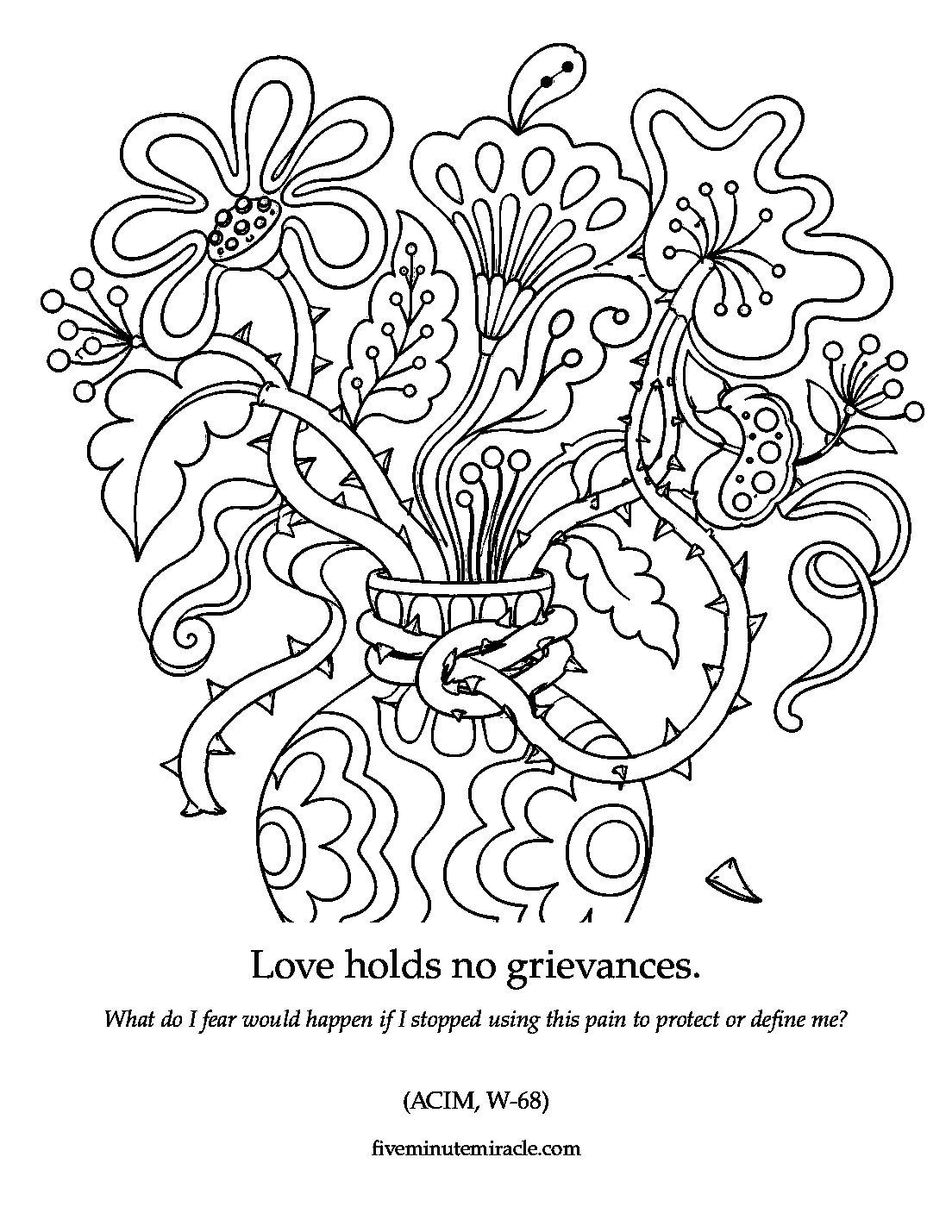
Color the lesson
Slow down and spend a little longer with today’s idea. Print this page and reflect as you color.
Designed for standard 8.5 × 11-inch paper.