Some losses cannot be reversed.
A person dies. A relationship ends. A version of the future is no longer available.
Forgiveness should not be used to suggest that grief exists only because I am thinking incorrectly.
What forgiveness can end is the additional suffering created by the meanings I attach to loss.
I once found an object that belonged to someone who was no longer here. The grief arrived immediately and honestly.
Then fear added its interpretation: the life connected to this object was over, and love now existed only behind me.
Forgiveness did not ask me to stop missing the person.
It questioned the conclusion that love had become inaccessible because its familiar form was gone.
Loss belongs to form. The relationship changes, the body leaves, and the future must be imagined differently. Love itself is not contained by the form through which I learned to recognize it.
Today I want to distinguish grief from the story that makes grief hopeless.
I do not need to rush toward an uplifting answer.
Forgiveness may begin as the willingness to admit that pain does not know everything about what remains.
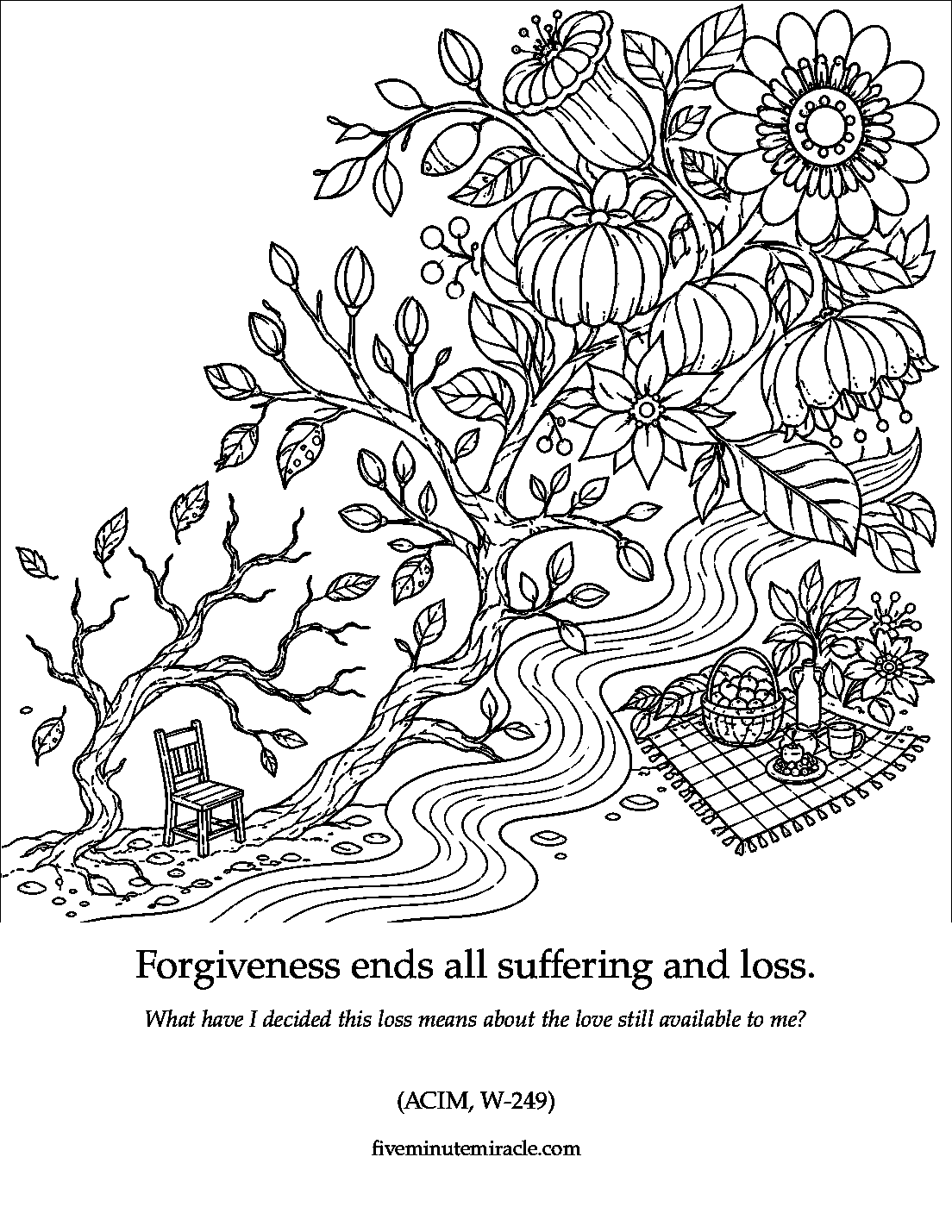
It does not erase the empty chair.
It releases the belief that emptiness is the final truth about the love that was shared there.
---
A PRIVATE REFLECTION
What is coming up for you?
Share what you are feeling, noticing, or struggling with. The companion will respond through the lens of this lesson—not as the final truth, but as another way of seeing.
Your words stay in this box until you choose “Reflect with me.” That sends them securely to OpenAI for this response. The Site does not save them. You can download the finished reflection if you want to keep it.
A QUIETER WAY TO PRACTICE
Color the lesson
Slow down and spend a little longer with today’s idea. Print this page and reflect as you color.
Designed for standard 8.5 × 11-inch paper.