There are identities that feel impossible to leave because other people have depended on them.
I become the capable one, the calm one, the helper, or the person who does not need much.
Then freedom can feel selfish.
I remember a family message assuming I would host a gathering because I had hosted it before. No one was being deliberately unfair, but my first answer was already forming before I checked whether I wanted—or was able—to do it again.
The role seemed more binding than the actual request.
If God is free and I am created by Him, then love cannot require an identity maintained through resentment.
Freedom did not mean abandoning everyone. It meant admitting that “I always do this” was not the same as “I am called to do this now.”
I said I could contribute without hosting and asked whether someone else wanted to choose the place. The answer exposed assumptions—including some of my own—but it also allowed a new arrangement to emerge.
The role loosened without the relationship collapsing.
Today I want to notice where I am treating a familiar pattern as a law.
I may freely choose to help again.
The difference is that giving no longer has to prove who I am.
God’s freedom is reflected in the ability to respond freshly, not in the obligation to repeat yesterday’s version of love.
A PRIVATE REFLECTION
What is coming up for you?
Share what you are feeling, noticing, or struggling with. The companion will respond through the lens of this lesson—not as the final truth, but as another way of seeing.
Your words stay in this box until you choose “Reflect with me.” That sends them securely to OpenAI for this response. The Site does not save them. You can download the finished reflection if you want to keep it.
A QUIETER WAY TO PRACTICE
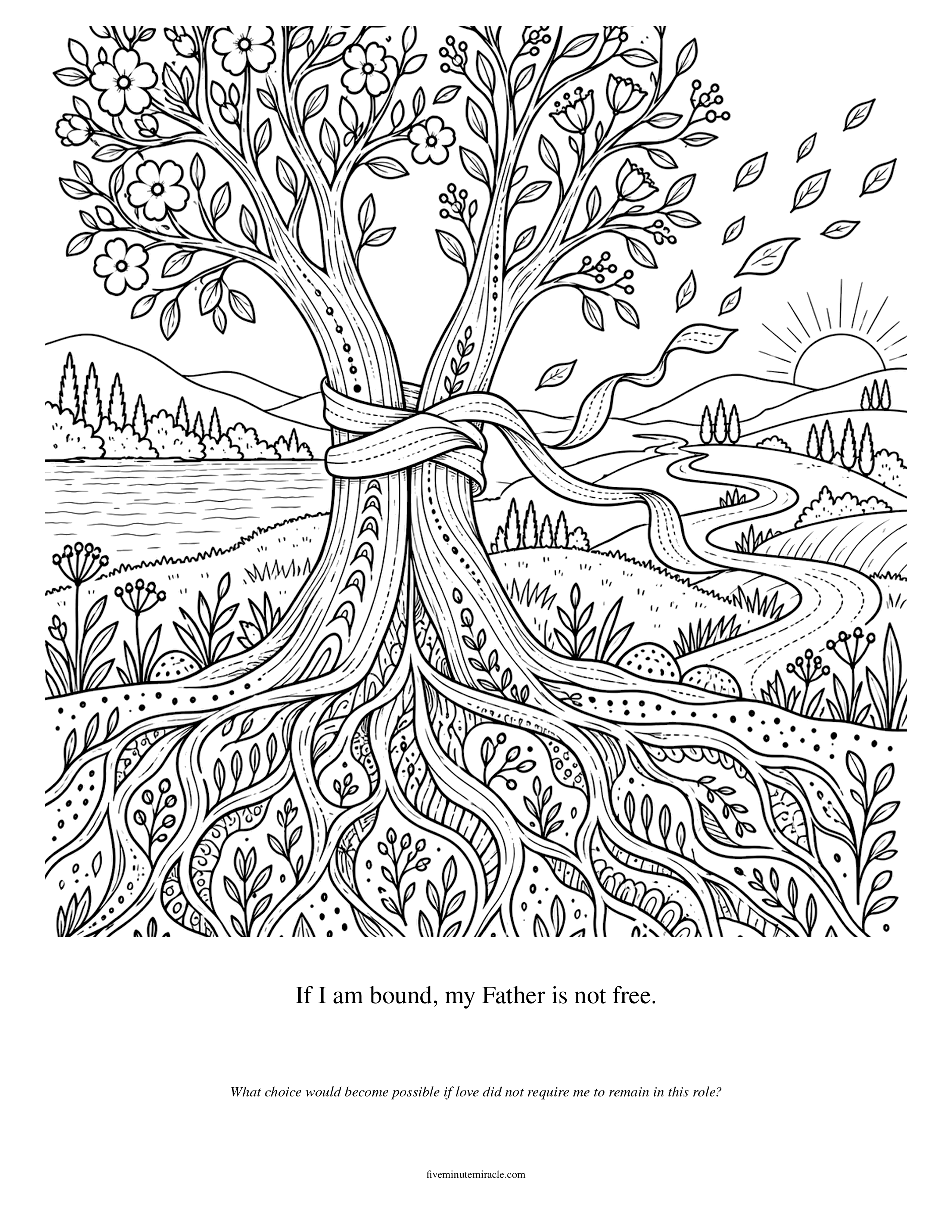
Color the lesson
Slow down and spend a little longer with today’s idea. Print this page and reflect as you color.
Designed for standard 8.5 × 11-inch paper.